Protect Our Parks!
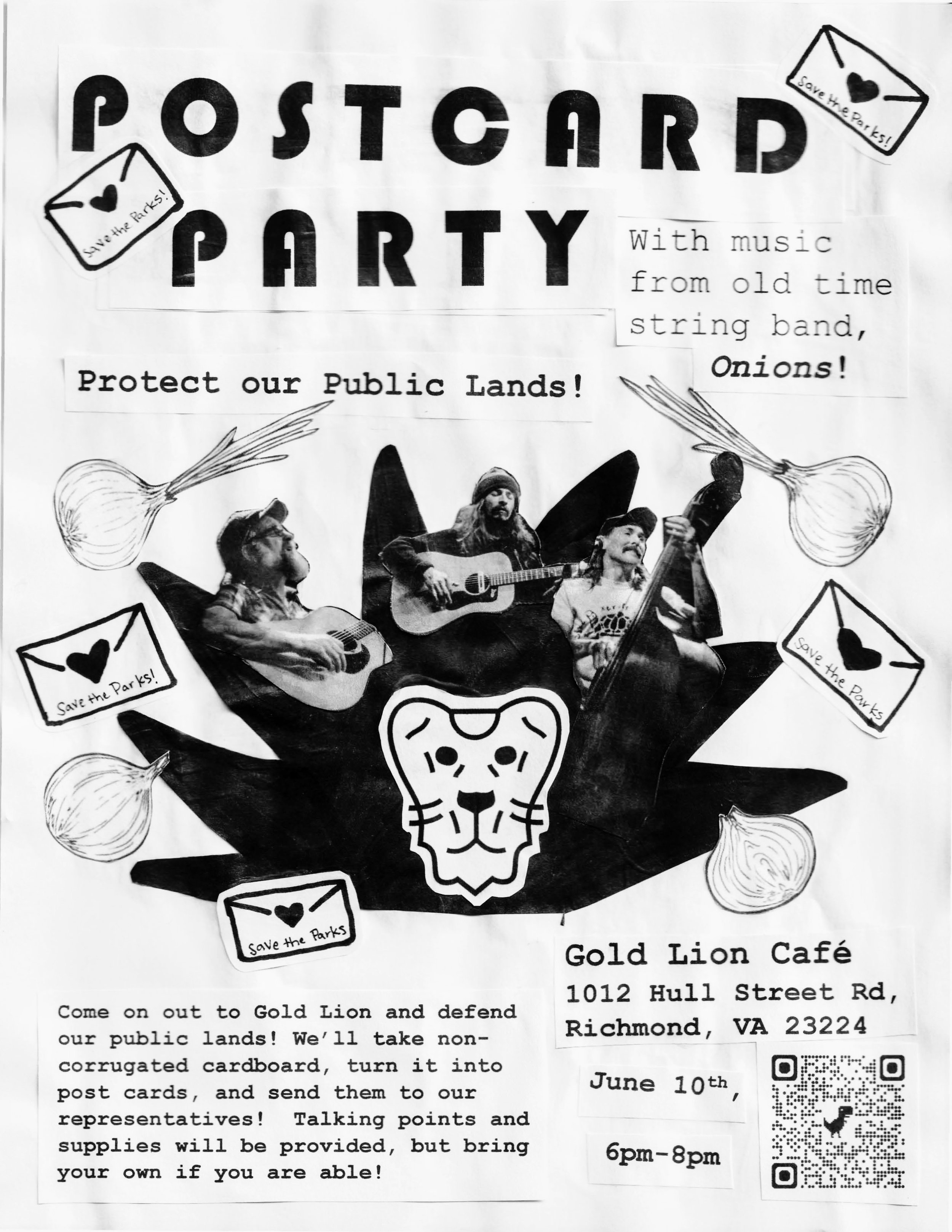
Next Postcard Party: June 10th at the Gold Lion Cafe with music by old string band Onions!
Postcard Project
I was inspired by The Simple Environmentalist’s call to action to advocate for our parks! We are currently at risk of losing environmental regulations that protect our health and safety, as well as losing public land protections that support healthy ecosystems and communities. There are many other very important causes to contact your senators about, but for this article, we’ll focus on our national parks and forests. Together we can save thin pieces of cardboard (the kinda cereal boxes are made out of), cut them into 4x6 postcards, write our hearts out, and send them to our senators. (Pro tip: Postcard stamps are also cheaper than regular stamps). Do it by yourself, with friends, or inspire others! Check out the hyperlink above for a step by step guide, or paste the following into your browser:
https://www.instagram.com/p/DKuUTglxWNg/?hl=en&img_index=1
I will bring cardboard, a few scissors, postcard stamps, and markers. If you are able please bring your own supplies, especially post card stamps!!
If you’re not sure what to write about, read below for a quick summary with external links on the impact and importance of our parks!
Why the Parks Matter
“Parks are key to ensuring the health of our environment because they play a critical role in maintaining healthy ecosystems, providing clean water and clean air, and enabling conservation of natural resources.”
-National Recreation and Park Association
Our public lands enrich our nation and the American people. They provide outdoor recreation, preserve our national resources, maintain healthy ecosystems and biodiversity, and provide a source of revenue for our nation. Healthy ecosystems and resources, such as clean water and air, result in a healthy and thriving population. They promote physical activity by provide a large amount of land to hike, kayak paddle board, bike, etc., resulting in better physical and mental health. Not only do the parks themselves generate profit, but the tourism supports many small, rural towns across America. They also provide accessible educational opportunities and build communities.
There is a lot of protected land in the United States. We often think of the lands protected by the National Park Service as public land, but our public lands also include land protected by the Bureau of Land Management, National Forest Service, and Fish and Wildlife Service.
Our National Park Service alone produced 55.6 billion in economic output in 2023. According to the Outdoor Industry Association, the outdoor industry generated $1.2 trillion in economic output and supported 5 million jobs in 2023. Their records also show 57.3% of all Americans aged six and older participate in outdoor activities. According to one study, households living near protected land areas are 16% less likely to live in poverty. The National Forest Foundation points to over 300 scientific studies that show how exposure to nature reduces stress, boosts our immune system, improves memory, helps reduce and manage chronic pain, and improve mental health. How will this industry suffer if our camp grounds are logged, mountain tops are removed, and the land is sold for private development? Where will we go to camp, climb, fish and reset? How many towns will disappear when the tourist have nothing to see?
There are many protections, regulations, laws, and rules being attacked by our current administration. It can be a lot to keep up with! The 5 Calls app is my go-to source for top issues our country is facing!. Organizations like the Outdoor Alliance (they have a great map of public lands under threat), Center for Biological Diversity, and the Wilderness Society are good to sources for up to date campaigns on protecting our wild lands. Companies like Field & Stream and REI also have ways to easily contact your representatives about protecting our public lands.
Current Issues
Highlighted RVA campaign: Protect our Urban Tree Canopy!,
Trees are vital for cooling the city and creating a more enjoyable city environment. Tree canopy coverage reduces home cooling costs and is associated with better physical and mental health, lower obesity rates, less cases of asthma, and improved social cohesion. We ask for better tree canopy protections and to stop cutting down historic woods and instead prioritize building on already impermeable surfaces like abandoned buildings and parking lots in commercial corridors. This approach will allow construction and development to continue, but will encourage unused impermeable spaces to be revitalized, while keeping established tree canopies intact. To read more about this specific issue, learn about the non-profits fighting to protect our tree coverage, and learn who in Richmond to contact, check out my article: Protect our Tree Canopy.
Keep the Roadless Rule!
The Roadless Rule not only limits road construction, but it also limits logging in 60 million acres in the National Forest System. Building and maintaining logging roads is not cheap. Based on the maintenance backlogs, repairing existing roads will require $6.4 billion. The protected forests ensure safe drinking water for around 60 million people by reducing flood risk, filtering water, and storing carbon. The Roadless Rule also prevents forest fires. Most fires are started by people and are often by roads. According to NPR, former Forest Service Chief Dale Bosworth claims areas protected by the Roadless Rule are not commercially viable to the timber industry due to the type of timber and how it expensive it would be to construct roads on the terrain. Only 11% of those polled by Pew Research want to open these protect areas to logging. In Virginia, over 332,000 acres would be at risk for logging and environmental degradation.
Clear-cutting, the most damaging method of logging, is the current administration’s preferred method of logging. Clear-cutting removes everything and exposes the soil to the elements, causing massive erosion, flooding, and landslidesthat choke our rivers and streams. Clear-cutting is more likely to result in destructive landslides than heavy rains. The increased runoff reduces the land’s ability to retain water and replenish our aquifers, further discussed by the Sierra Club.
The final decision on rescinding the Roadless Rule has been pushed back to late 2026.
No Border Wall in Big Bend!
A border wall in Big Bend National Park will be devastating to wildlife. The wall will prevent wildlife crossings, cutting wildlife off from water and food. This is incredibly devastating in the desert environment where the river is often the only place that offers food and water. Not only does this affect biodiversity, but it will kill many big game animals that Texas prides itself on.
The wall will destroy the The La Junta Archeological District. It is home to many culturally significant sites like ancient villages and cemeteries. Lights from construction threaten the parks status as an International Dark Sky Reserve. Degrading the park will affect the $56.8 million it contributes to the local economy from tourism.
See https://nobigbendwall.org/ for more information and ways to get involved.
Say no to glyphosate in our forests!
The Forest Service has announced plans to spray forest areas affected by wild fires with glyphosate. This will kill all plants except commercially viable pines and Douglas firs. These trees have needles rather than leaves, which allows them to tolerate the chemical better. They will spray the chemical in campgrounds, along trails, and even near private residences. Glyphosate is linked to a number of health issues like cancer, liver damage, neuro-inflammation, and altered gut microbiota. Bayer has paid more than $12 billion to lawsuits over the safety of the chemical. The website Right to Know lists the extensive health risks from exposure to glyphosate, including possible links to infertility, ALS, and Alzheimer’s, and adolescent brain function.
Read the Mother Jones investigation here.
Personal Thoughts on our Public Lands
There have been examples of resource mismanagement by various national land bureaus (see the American Chestnut tree), but I never thought they would ever be put up for sale. When I first heard the news that we could lose millions of acres of private land, I couldn’t even process that it was real. How could people not know how important our public lands are? How could they not see the larger network and community that it supports? In communities and relationships, it’s important to remember to consistently express gratitude for the people around us and all the things they do for us. Even if you expressed your appreciation for a partner or roommate cleaning the floors last week, you thank them the next time they clean the floors. Had we forgotten to remind everyone about all the things our public lands continuously do for us? Did our representatives not know how important our lands are and all they do for us? Are we so far removed from nature, that we forgot how we depend on it? Recent developments show that our representatives are pulling back on the public land sale. HOWEVER, if they considered it once, they’ll consider it again. We must continue to remind them to keep our lands public and wild.
I’ve spent many summers and holidays visiting family nestled in the George Washington and Jefferson National Forests. I flyfished among cattle on the rivers and creeks. I’ve floated on the waters of the Jackson River. I have memories catching crawdads with my cousins in the cold, crystal clear headwater streams of the Alleghany Highlands. I’ve been speechless as I drive over the mountain top as storm clouds form in the distance. The forests and the parks are home and belonging. We must remember to thank our lands, and let others know their importance to our lives. When we invest in our lands, we invest in our culture and our people.
Public Officials’ Contact Information
White House
Office of the President
1600 Pennsylvania Avenue, N.W.
Washington, DC 20500
The White House
Office of the Vice President
1600 Pennsylvania Avenue, N.W.
Washington, DC 20500
Doug Bergman - Secretary of the Interior
Department of the Interior
1849 C Street, N.W.
Washington DC 20240
Virginia
703 Hart Senate Office Building
Washington DC 20510
(202) 224-2023
231 Russell Senate Office Building
Washington DC 20510
(202) 224-4024
Robert Wittman - House Representative - 1st District
2055 Rayburn House Office Building
Washington DC 20515
(202) 225-4261
Jennifer Kiggans - House Representative - 2nd District - Natural Resource Committee
152 Cannon House Office Building
Washington DC 20515
(202) 225-4215
Robert Scott - House Representative - 3rd District
2328 Rayburn House Office Building
Washington DC 20515
(202) 225-8351
Jennifer McClellan - House Representative - 4th District
1628 Longworth House Office Building
Washington DC 20515
(202) 225-6365
John McGuire - House Representative - 5th District
1013 Longworth House Office Building
Washington DC 20515
(202) 225-4711
Ben Cline - House Representative - 6th District
2443 Rayburn House Office Building
Washington DC 20515
(202) 225-5431
Eugene Vindman - House Representative - 7th District
1005 Longworth House Office Building
Washington DC 20515
(202) 225-2815
Donald Beyer - House Representative - 8th District
1226 Longworth House Office Building
Washington DC 20515
(202) 225-4376
H. Griffith - House Representative - 9th District
2110 Rayburn House Office Building
Washington DC 20515
(202) 225-3861
Suhas Subramanyam - House Representative - 10th District
1009 Longworth House Office Building
Washington DC 20515
(202) 225-5136
Vacancy - 11th District
Links to all US Senators
AlabamaAlaskaArizonaArkansasCaliforniaColoradoConnecticutDelawareFloridaGeorgiaHawaiiIdahoIllinoisIndianaIowaKansasKentuckyLouisianaMaineMarylandMassachusettsMichiganMinnesotaMississippiMissouriMontanaNebraskaNevadaNew HampshireNew JerseyNew MexicoNew YorkNorth CarolinaNorth DakotaOhioOklahomaOregonPennsylvaniaRhode IslandSouth CarolinaSouth DakotaTennesseeTexasUtahVermontVirginiaWashingtonWest VirginiaWisconsinWyomingLink to all US House Representatives
Link to all US House Representatives
US Representatives are located in three office buildings. CHOB is short for Cannon House Office Building. LHOB is short for Longworth House Office Building. RHOB is short for Rayburn House Office building. To send mail to your representative, you will write out the long form of their office room on the link above. All buildings are located in Washington DC, 20515.
For example, Alabama’s house representative Barry Moore of the first district is in office room 1511 LHOB. His address is written as:
Barry Moore
1511 Longworth House Office Building
Washington DC 20515